This case study uses a dated Breaking snapshot built around Iran successfully targets shipping by July 7? and Iran successfully targets shipping on July 7?. The original article looked too much like a general restoration-market explainer. This rewrite gives the page a clearer job: show how an operational proof window can become the real thing being priced.
For a beginner, the useful question is not only whether a shipping-risk event is serious. It is whether the required event, observation, and confirmation can still fit inside the contract window.
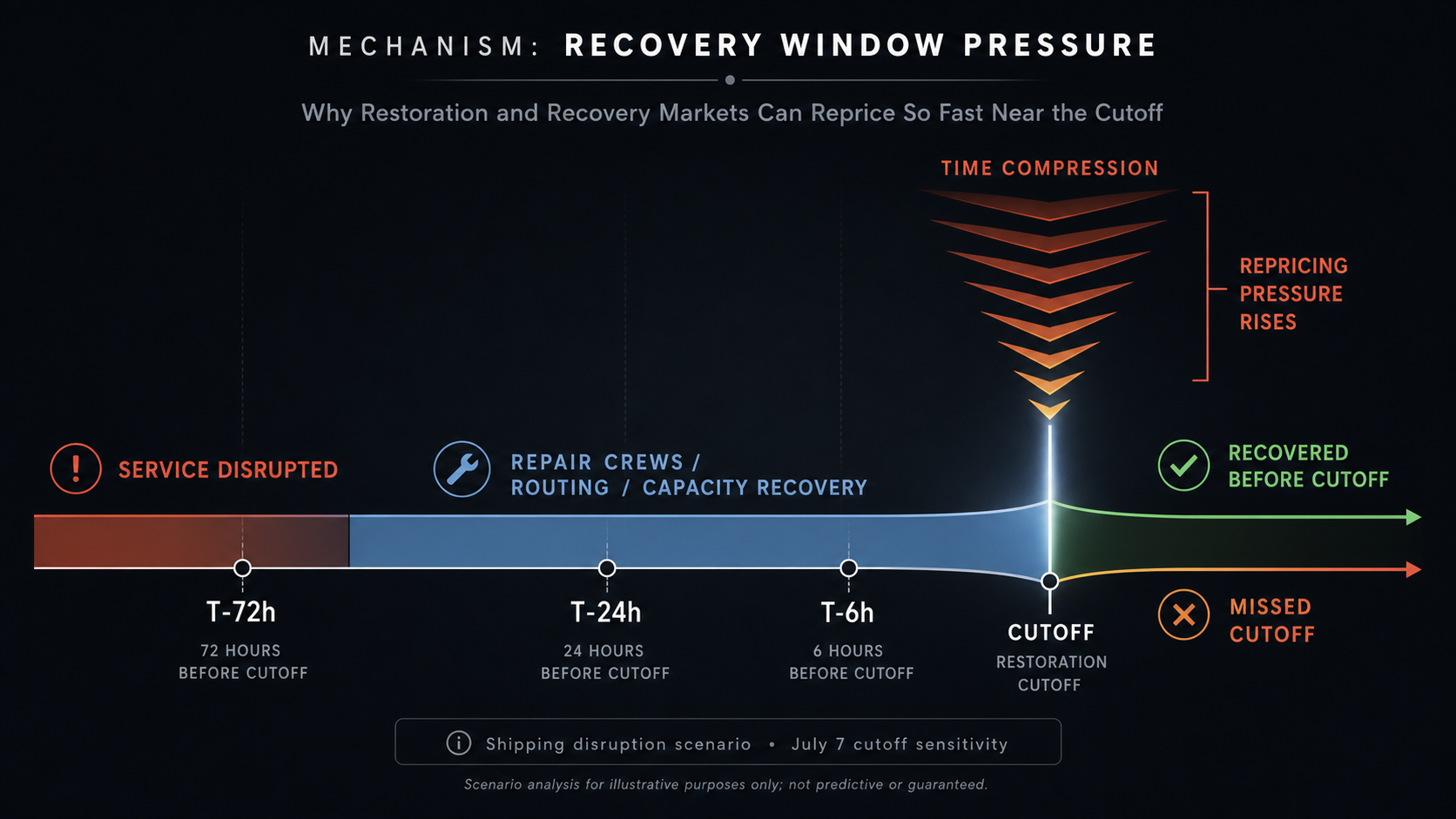
Why this is a proof-window case
Operational markets often depend on more than the event itself. Something has to happen in the real world, then become visible through a source the market can use. In shipping-risk questions, that can mean reports, observable disruptions, official statements, platform resolution judgment, or other evidence channels.
Near a deadline, the market may start pricing the proof window more than the headline. The broad story can remain tense while the practical chance of a countable event shrinks.
The operational proof-window framework
| Layer | Case-study question | Why it matters |
|---|---|---|
| Operational event | Did the shipping-related event happen in a way that matches the contract? | The event must fit the wording, not just the news theme. |
| Visibility | Can outside observers see enough evidence? | A hidden or ambiguous event may not resolve cleanly. |
| Timing | Can evidence arrive before the cutoff? | Late proof can be equivalent to no proof for the market. |
| Resolution source | Which source or judgment controls the final answer? | Different sources can produce different practical windows. |
How this differs from the recovery canonical page
The canonical restoration page explains broad recovery-window logic: broken systems, service return, partial recovery, and verification lag. This dated case study is narrower. It is about operational proof in a risk event. The question is not “will a service recover?” but “can a specific operational claim become countable before time runs out?”
That distinction is why this page should not compete with the canonical page. It uses a dated example to teach one sub-case: proof can be the bottleneck even when the underlying story remains active.

What beginners usually misread
- They treat risk as resolution. A tense environment does not automatically satisfy a contract.
- They ignore the evidence path. The market may need a source that can verify the event, not just speculation.
- They miss wording differences. “By July 7” and “on July 7” can create different proof windows.
- They assume late information has the same value. Near the cutoff, late proof may arrive too late to matter.
What this case study does not prove
It does not say whether a particular market was efficient. It does not claim that every shipping or security market should be read the same way. The point is more practical: when a contract depends on observable operational proof, the remaining evidence window can drive the price.
How to read the next operational-risk market
- Identify the exact event wording.
- Identify what kind of evidence would count.
- Ask whether the event and evidence can both fit before the cutoff.
- Separate broad geopolitical relevance from contract-specific proof.
- Compare similar markets only after checking whether their deadlines and wording match.

Why this page should remain separate from the canonical guide
This page has a different job from the broader recovery-window guide. The canonical page teaches the general mechanism. This case study preserves a dated cluster where two similar shipping questions forced readers to compare wording, proof, and deadline pressure at the same time. That makes it useful as an example page rather than another evergreen definition page.
The practical lesson is that operational proof markets can become narrow before the public story feels resolved. A beginner who learns to spot that mismatch can read future Breaking markets with more discipline.